Tumblr Popular Post Fitted Layered Look Men's Fashion
Men's mode ca. 1830: The bottom layers
The longest postal service in the history of the world, and no, I am not proud of that. I am apologizing in advance for when information technology breaks everyone's tumblrs.
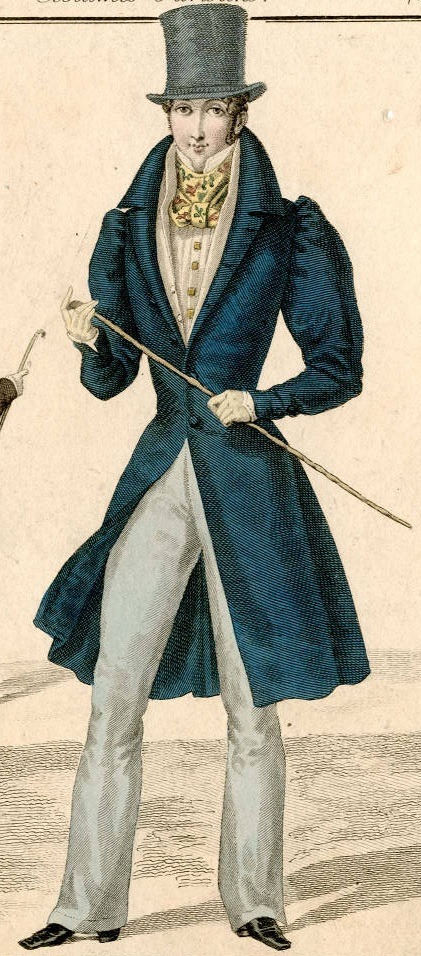
^^^This is our object of study: the well-dressed male person of 1825-1835. The silhouette of the ca. 1830 gentleman bears an interesting resemblance to that of his female counterpart: an hourglass figure, exaggerated past having extra puff in the sleeves, extra width and height in the collar, actress trunk in the skirt of the coat, and a tightly cinched waist. Both the male person and female silhouettes rely on sloping shoulders, a padded breast, a narrow waist, and a lot of curves in the hips:
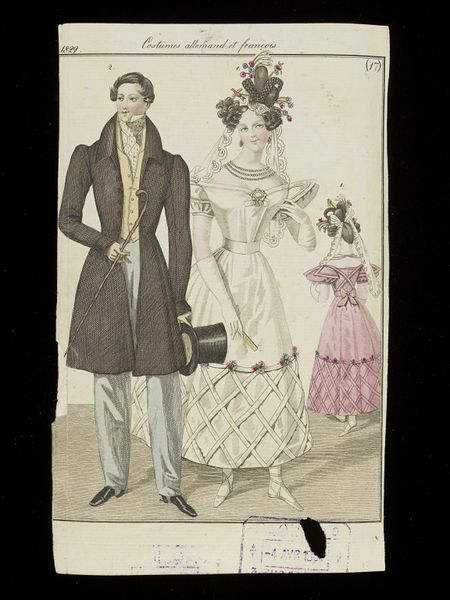
Merely as with the ladies, we should start past asking what goes underneath.

^^^Probably from the earlier end of our flow of study (ca. 1825).

^^^Probably from the later end (ca. 1835).
The most bones layers to a ca. 1830 male outfit are essentially iii: ane.) the shirt; two.) the trousers; and 3.) the braces. Sometimes underwear is involved as well, only that'south questionable. Every bit far as these men were concerned, their shirt was their underwear, and, similar to the ladies' chemise, the shirt can be considered the base of operations layer (and the layer virtually improper to testify in public).
It sounds pretty grotesque, only aside from extant clothing, some of the best means to become a skillful look at these under-layers of male wear are A.) drawings of dead or injured people on barricades, and B.) pornography (as usual). Ironically, female undergarments are represented more commonly than male ones in images of the period, obviously considering the artists and their audience were mostly heterosexual men who liked to get their kicks drawing/looking at half-naked ladies. Men virtually never represented their own undergarments in images, though, except in the above circumstances. Fine art showing barricade fighters in 1830 is good for looking at shirts and braces. I'll give a few examples when I can. Pornography is good for looking at how trousers piece of work (duh), plus other fun things like nightshirts and such. No, I'm not going to requite any examples here. Simply if one were hypothetically to search for "Achille Deveria" on Google Images, I think it would become obvious what I hateful. Hypothetically, of grade. >__> Even allowing for some artistic license that might stretch the truth of how these garments really worked, these sources shouldn't be ignored by the costume historian, because what other chances do nosotros have to run across people of the past in a land of undress?
Shirts first!

^^^An 1820s extant example.
Men's shirts ca. 1830 were cut a fleck loose and long (long plenty to cover the genitals), usually with a slit on each side for mobility:

The collars of these shirts are hands recognizable to anyone familiar with portraits of this period. They were cutting high in order to adjust the tall cravats/stocks of the flow and were closed with i or 2 buttons before the cravat was tied. They could exist worn stiff and upright, which would cover role of the jawline, or soft and folded down over the cravat.

^^^The collar of the shirt can be seen extending upward from the cravat, covering the sides of his jaw and whiskers.

^^^Showing the push button closure on the collar, which would be hidden beneath the cravat when the man is fully dressed. Yous can see how stiff the collar tin be.
These shirts were opened and airtight by way of a front middle placket set with buttons, simply the placket did non extend all the manner to the lesser hem. In laymen's terms, this meant that, since it could not be unbuttoned all the style downwards, the shirt had to be pulled on and off over the head. This is what we would now call a "tuxedo front":

The sleeves of the shirt had to fit beneath fairly tight coat sleeves, so they could non be likewise voluminous, but they did have extra material that was gathered to the sleeve holes and cuffs using knife pleats or cartridge pleats. The sleeve pigsty for these shirts is always cut depression on the shoulder, and then that the sleeve pleats really sit downwardly the arm a few inches instead of right on top of the shoulder, like so:


This is done so that there won't be an uncomfortable, lumpy gather of material right underneath the coat shoulder seam; instead, it shifts that mass of shirt fabric down into the virtually roomy, puffed part of the coat sleeve, where information technology won't beal the wearer too much.
A really fashionable shirt might take cuffs cutting longer than standard modern cuffs; they would be more comparable in length to what we now telephone call the "French gage." This was so that they would extend merely slightly beyond the long cuff of the coat, sometimes virtually to the man'south knuckles:

Shirt cuffs must have been cutting to flare out a scrap and then that the man could retain full mobility in his hands while wearing them.
The front of a ca. 1830 shirt is a production of waistcoat design. In previous decades, waistcoats had been cut college, such that they covered pretty much the whole front of the shirt, upwardly to the cravat. In this period, some types of waistcoat are beginning to be cut lower than in previous periods, meaning that more of the shirt forepart is being exposed. This means new designs of shirt are coming into fashion. 1825-1835 shirts can come with a front ruffle or without. When without, the forepart of the shirt is often pin-tucked into small vertical decorative pleats. Shirts with a ruffle are more than conservative, fashion-speaking, a holdover from earlier decades. Without ruffle will exist the future of the 19th-century shirt.

^^^An 1820s shirt, probably from the early years of the decade. At that place is no decoration on the shirt front, just gathering/cartridge pleating that joins the shirt front to the neckband. This probably indicates that this shirt was worn with a high-necked waistcoat and a large cravat that didn't allow any of the shirt front to prove beneath.

^^^An 1826 shirt with a ruffled forepart: another older style of shirt.

^^^A late 1820s shirt, still ruffled.

^^^An 1820s shirt with a pleated front, possibly from the later half of the decade. The style is still somewhat unrefined, with wide, clumsy pleats instead of the fine, frail ones that would come up into fashion in the 1830s.

^^^An 1830 formal shirt, still retaining the conservative ruffle.

^^^An 1830 informal shirt, with pin-tucked pleats.

^^^An 1832 shirt with a plain front (or pin-tucked pleats, it's hard to tell). By this point, pleated or obviously shirt fronts are definitely squeezing out the ruffled shirts.

^^^An 1832 shirt with tiny pivot-tucked pleats.
More illustration of how the placket in the front works (on dead people, sadly):

^^^With braces also.


You come across that the shirts tin't unbutton all the way–in the centre instance, it'due south articulate that the shirt is open as far equally it will go. Important to remember when writing scenes of men dressing and undressing: shirts get over the head.
Shirts were typically fabricated of linen (non cotton fiber), and generally the wealthier the wearer, the finer the material and the whiter the color. (Linen is not naturally white in color, information technology's like a light tannish color, so information technology needs to be bleached to get a white color.) These shirts were the man's underwear, and, like the ladies' chemise, they would be the layer to sustain all the wear-and-tear, the sweat stains, the stank of everyday wearing. Like the chemise, they would need to be sent to the laundress pretty oftentimes, and so a human would hopefully have the means to keep a number of them to cycle through. With the laundress, the shirts would be washed and bleached, and the collars could possibly be re-stiffened with starch.
Before talking nearly trousers, nosotros need to touch on the possibility of underwear, or "small wearing apparel," equally they're sometimes called.

^^^A ca. 1810 example of "small-scale dress." These have a unproblematic drawstring waist and are made of linen (I believe).
Underwear meant to be worn beneath trousers or culottes definitely existed–there are surviving examples. Whether they were in widespread use is unclear. It seems to me that, as with ladies' drawers, there are more surviving examples of underwear for the decades earlier our period of study, and peculiarly underwear meant to get under culottes (articulatio genus-length breeches), like these:

The 1810 "small clothes" case is the just one I've found that appears to be designed specifically for use under long trousers. I mean, one can see why underwear would exist, ahem, a practiced idea, especially because how dreadfully tight these trousers could be. On the other paw, considering how dreadfully tight these trousers could exist, the unfashionable pantyline yous'd get from boxer-briefs like these is pretty lamentable to recollect about. I've heard that shirttails in this period were then long considering they were meant to kinda tuck around your parts and act every bit underwear. Hm. On the other other manus, if y'all were wearing leather riding breeches, it would seem prudent to put something substantial between your bits and that chafing leather, yikes!
And then, trousers. Typical trousers of this catamenia take a distinctive cutting, very different from modern trousers, simply quite suitable for the needs of the overall outfit ca. 1830. Firstly, they accept an extremely high waist, so that the waistcoat can solidly overlap them, so that you'll never take that bad-mannered moment when you "flash" polite visitor with a glimpse of your shirt. Secondly, these trousers are similar to waistcoats in that they have two fastening devices: a fly of some kind in the front (normally a buttoned autumn front end fly), and and so a tightening device in the dorsum, whether laces or a buckle. Thirdly, these trousers often take stirrups at the lesser of the leg, which go around the shoe and hold the trouser legs down. And fourthly, these trousers are almost always cut with a baggy seat, even if the legs are cut to be tight (though pantaloons are sometimes tight throughout).


Why the amorphous butt? Hm. I always assumed information technology was to permit greater mobility, simply it could serve a number of other purposes, from modesty (speaks for itself) to better fit (allows for the pants to be adjusted to fit a greater range of torso shapes) to silhouette (actress fabric around the barrel and hips gives more fashionable flare to the coat skirt on top of information technology). Maybe all of the above.

^^^I knew the 2012 musical movie of Les Mis was going to exist a "Serious" adaptation when photos of these beauteously baggy pants came to light. Without amorphous butt pants, your Les Mis is simply, well, the stage musical:

No baggy seat here, no sir.
In general, the musical movie had lovely historically-accurate trousers for its men:

Ca. 1830 trousers came in several types, with three main variables to distinguish them: the textile they're made of, the cutting of the leg (length, width, tightness), and the type of wing closure.
The material that trousers are made of depends on what they're being used for. If the trousers are for riding, they're usually fabricated of leather, like this crazy green (!) pair:


Short breeches are often used for riding (they allow for greater range of motility in the knees, presumably), but as the higher up example shows, they could use full-length trousers besides.
If trousers are just regular 24-hour interval dress trousers, they're made of linen or cotton. If they're evening dress pantaloons, they could be made of linen or some silk blend.
In Les Misérables, Victor Hugo writes lovingly about trousers made of a textile chosen cuir de laine, which were apparently something of a catchword for stylish dress ca. 1830. When Joly is lamenting his estrangement from his mistress Musichetta, Bahorel'due south advice involves these magical trousers: "'My dear [said Bahorel], so y'all have to please her, be stylish, brand effects with your knees. Purchase a practiced pair of cuir de laine trousers at Staub's. They help.'" (Grantaire's rejoinder–"'How much?'"–reminds us of the enormous expense of being in manner. The absurdity of using pants to heal one's cleaved relationships is not lost on me, but apparently cuir de laine trousers were so awesomely-omg-incredible that they were worth the expense. ;)) But what is cuir de laine? At first glance, i might interpret "wool-leather," or maybe "lambskin." The Fahnestock/MacAfee/Wilbour translation inexplicably translates "doeskin" in the above passage, only "double-milled cassimere" for the same phrase in a afterwards passage. (I'll requite them the benefit of the doubt and assume by "doeskin," they mean the cloth chosen doeskin, non the bodily pare of a deer.) As information technology turns out,cuir de laine is indeed a woven fabric, not a leather: the 1831 supplement to the Dictionary of the Académie Française defines cuir de laine as "a woolen cloth, very heavy." This woolen fabric, then, seems to be another stylish choice for trousers, though virtually of the examples of long pants that survive today are made of linen, not wool. (Culottes, that is, breeches, are more than normally fabricated of wool.) Staub's, equally implied in the Hugo quotation, was the premier tailor's shop in Paris in this period, and was referenced as such by other writers of the time as well (notably Balzac). I'll discuss tailors at more length in a subsequently post (when I take more space to spare!).
Every bit for color, trousers normally come either in black or, more commonly, in some light neutral color somewhere betwixt white and tan. Considering these pants are made of linen or cotton, an off-white, yellowish, or tan colour could be the natural color of these fibers.
Nankeen was a popular cloth used for trousers, known for its yellowish color:

Nankeen gets its name from Nanking/Nanjing, the Chinese city that used to produce this fabric from a cotton with a natural yellowish colour. In later years, regular cotton wool was dyed to have this yellow color, and this also was known as nankeen. It was a material highly in need in a catamenia that valued light-colored trousers.
Besides cream or xanthous or tan, sometimes you come across pants represented in some other low-cal tone, like a pale blue-gray:

(I'm never sure if fashion plates are colored that way to stand for white pants, or if they really mean that pants came in a light blue-greyness. I oasis't nonetheless seen an extant case that was really that colour, though since fabric dyes can dethrone over fourth dimension, peradventure I shouldn't expect to…?)

^^^A range of trouser colors on display in this 1830 image.
The cut of the trousers' legs tin can vary quite a lot in this menstruation. There are some that are cut broad, loose, and amorphous from tiptop to lesser. At that place are others cutting as tight equally modern leggings or skinny jeans. Some are tight in the legs and baggy in the seat, while others are tight throughout. Some have a straight, loose leg, while others have a leg that tapers down from a broad hip to a narrow ankle, while notwithstanding others have the opposite (a leg tapering from a tighter hip to a wide ankle, like a modern kicking cut or even bell-bottom). Some are cut with a rather high talocrural joint hem (i.e., the trousers end above the ankle), while others are cut like a modern kick cut and practically touch on the ground behind the heel. Some have stirrups and others do not. Some of this variation is year-to-twelvemonth (as in, some cuts are more popular in 1825 than in 1835), but some is within the same twelvemonth (as in, within 1830 lone, several dissimilar types of cut are possible).
Some examples:


^^^Child and adult versions don't differ besides much.


Besides regular day dress trousers, which most of the higher up examples illustrate, at that place were trousers meliorate known every bit pantaloons, which were cutting very tight and intended for evening/formal dress:


^^^Cute socks!


^^^Note the curvy cutting of these, meant to hug the leg. Linen itself is non an especially stretchy textile, then just as with medieval leggings, 19th-century pantaloons were cut to the shape of the leg and cut on the bias to give the fabric extra stretch. As well notation the buttons along the ankle: absolutely necessary to fit tight-ass leggings over the foot (as many people today surely know well).
The fly on trousers is one of their virtually of import features and another detail that varies from one pair to another. There are two families of wing in this period: autumn forepart, and center. Fall forepart flys are far more common in the 1820s-early 1830s, with the center wing gaining ground from the later 1830s onwards. Fall front flys tin exist either wide…

…or narrow…

…merely both types plain serve a practical purpose.
A broad fall is defined as a flap extending all the manner to the side seams: in other words, across the entire front of the trousers. A narrow fall is a flap that only opens about 25-50% of the front and is constructed from a more complicated pattern. (Urg, the hardest thing ever to make a pattern for…)

The flap is held onto the pants past buttons, ordinarily three across the elevation for a narrow autumn and five for a wide fall, every bit seen in the above examples. The mystery is what lies beneath the flap (no, you dirty-minded people, I mean how the trousers are synthetic beneath!). Permit's come across the 2 to a higher place examples open:


Button sky! Can you imagine being in a blitz to take a piss? Or, even worse, being drunk out of your heed and being in a rush to accept a piss?
You can meet that in that location are ii-three buttons assigned just to agree the waistband closed. The lesser-almost push button on the waistband doubles as the center button keeping the autumn front fly closed. So in that location are 2 buttons below the waistband, to go along closed the modesty panel below the fly. (Anyone who's seen these things in action should remember that the fly does buckle upward a bit when a guy sits, so a modesty panel is necessary to keep, um, impertinent ladies' prying optics out.) There are an boosted 2-four buttons on the sides to keep the rest of the wing closed, then fifty-fifty more buttons lined up above those, along the tiptop hem of the waistband, which are where the braces are supposed to button onto the trousers. Whew!
The autumn front end wing had been around since earlier trousers had been around. The 1790s sans-culottes abased their culottes for trousers similar these…

…but the fly remained the same as that establish on culottes. (BTW, who doesn't dearest sans-culottes trousers in cute patriotic tricolor stripes?)
Here are some interesting fly pictures:


^^^These two shots testify the corner buttons of a broad fall fly, but also the line of buttons above it, where the braces would exist buttoned on.

^^^Lots of buttons! To close the waistband, to close the wing, to attach the braces.


^^^Two shots of an earlier broad fall closure (ca. 1810). He fifty-fifty has some piffling hugger-mugger pockets there under his fall! (And then ladies, if you are offended one twenty-four hour period to see a guy rudely groping around in his autumn front wing, he may not be "adjusting himself," he may simply exist looking for some modify in his pocket.) He too has a tiny pocket in the waistband, which many of these examples seem to have.

^^^An extremely narrow fall forepart fly, only wide plenty to take intendance of business. This is what the front looks like when closed:


^^^Two pictures of a center fly closed with buttons. The center fly of course somewhen superseded the fall front fly to become the most pop style of wing. This detail case has so many buttons that it's actually no more efficient than the autumn-front fly (and perhaps less efficient, if you're 1 of those lazy guys who just whips it out of the fall front wing without bothering to unbutton also much).
Before we look at braces, I should say that most of what we look at in these posts is fashionable clothes. At that place is of course a simpler style of trousers that persists amid working-class men from the time of the sans-culottes all the mode up to the 20th century. It is substantially a basic gear up of trousers with a fall front end wing, a straight, roomy leg, a baggy seat, and a little slit at the ankles for easier dressing:


In that location also remain plenty of examples of earlier styles circumstantial with fashionable trousers. Culottes are nevertheless common among older or manner-conservative people, and for sure social functions:


Finally, braces.
Braces are there to concord upward the trousers. They are fastened to the top of the trousers past buttons (not clasps like modern-solar day suspenders) and they are meant to prevarication completely subconscious below the waistcoat. Of class, that did not stop fashionable dudes from seeking out fancy decorative ones that no i (except their girl/boyfriend?) would ever see.


Let's go back to this fellow:

You tin can see those decorative braces there over his shirt.
We saw plenty of buttons for braces on the front end of trousers. Here'south what the dorsum buttons look like (the middle triangle of fabric is the adaptable insert, where the pants would be tightened with a lace):

In this detail from Delacroix's painting "Freedom Leading the People," you can meet the fall forepart fly of a soldier'due south trousers (partially unbuttoned), and the braces buttoned to the superlative of the trousers:

On the other side of the painting, at that place's this guy, a workingman:

At first I idea he was wearing an apron over his shirt/trousers (many workingmen wear these), just at present I'thousand thinking he's just wearing his trousers especially high. Y'all can see his braces there, holding his trousers up.
Okay, so nosotros've got an 1830 human being in a shirt, trousers, and braces. He'southward going to reach for a cravat next, then a waistcoat, and finally a coat. At present let'southward suppose that our homo has maybe a little scrap of babe fat around the belly, or possibly doesn't exactly have the most ripped pecs, or possibly he has skinny little legs that don't cut a nice figure in pare-tight pantaloons. As Balzac once put it, in the 1830s "men still showed off their bodies, to the great despair of the sparse or desperately-built." What'south a fashionable swain to do to accomplish an unrealistically curvy hourglass silhouette? Why, the same thing his girlfriend would practise: he'll corset what's sticking out and he'll pad what's sunken in.

^^^A extravaganza showing a neat. Notation the foreign corset bodice (information technology bears more than resemblance to a female corset of the time than a male ane). His glaze sleeves are going to be and so tight, he tin can't fifty-fifty have shirt sleeves underneath, just a little false dickey and cuffs.

^^^Not only corseting, but also padding for sadly skinny hips, calves, and shoulders.


^^^Lampooning the "feminized" and highly corseted style popular with military machine officers of the menstruation. The cartoonist seems to proverb that this lancer is so gussied up that he looks like a pretty young lady!

^^^A typical shape for a male corset. It's cutting similar a cummerbund, basically, and unlike a lady'due south corset, it pretty much only concerns itself with squishing in the abdomen. It uses vertical strips of either boning or cording to shape the body, and information technology'due south fastened in the dorsum with loops and buttons. As the pictures higher up seem to betoken, information technology would accept been worn over the shirt and nether the waistcoat.
More male person corsets:

^^^Front.

^^^Back fastening.

^^^Front.

^^^Unfastened.

^^^These pants seem to have a built-in corset office, with boning and laces sewn right into the pants.
Courfeyrac and other super-fashionable gentlemen would accept been all over these homo-corsets, just it's not clear to what extent the boilerplate guy used them. I'chiliad guessing the average guy back then wasn't too dissimilar from the average guy now–he dressed up when he needed to (i.due east., to get laid), and didn't worry about it all the residual of the time.
So, to sum up:


Gorgeous pants make for gorgeous silhouettes. (And man-corsets don't hurt either.)
When y'all see what fashionable guys have to expect forward to ca. 1840, information technology makes ca. 1830 look mild by comparing:

Yikes!
0 Response to "Tumblr Popular Post Fitted Layered Look Men's Fashion"
Post a Comment